Scaffolding
-
Authentic Learning and CCSS
SBAC and PARC problems used to test CCSS are challenging and often draw upon context unfamiliar to students. This means students must navigate the content, problem solving and deciphering context. Below is an SBAC problem dealing with photo albums…PHOTO ALBUMS. Do kids today understand this? In the subsequent pictures you will see the…
-
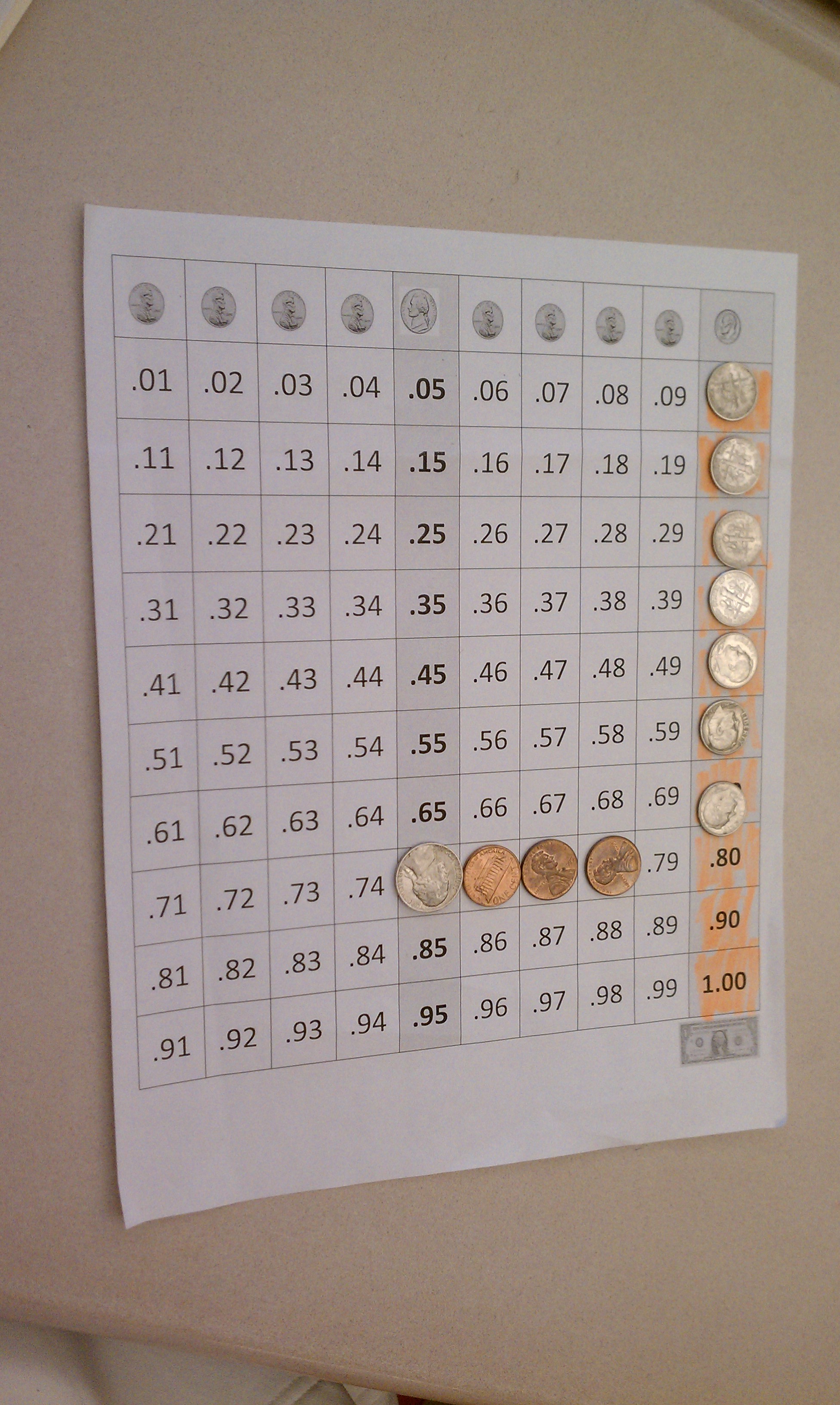
Counting Out Total Value of Coins
-
Adding Money First Steps
The following shows steps to introducing the concept of the value of money and of adding coins. The concept of a dime is presented as 10 pennies (see below). The dime is compared to a penny, nickel and quarter using these representations. Repeated use of these representations leads into an intuitive understanding of the coins.…
-
Interpreting Slope Intercept
Slope is one of the most important topics covered in high school algebra yet it is one of the least understood concepts. I have two observations about this. First, slope is often introduced with the formula and not as a rate of change. Second, students intuitively understand slope as rate of change conceptually when presented…
-
Intro to Slope as Rate of Change
-
Number Lines to Represent Percents
I am following the blog Adventures at the Pond (author has some great stuff!) and the following photo was posted on this blog. This is an excellent alternate representation of a concept. I do not know how the author would present this in class but here’s what I would do. I would give the students the…
-
Graphic better than FOIL
Typically, multiplying two binomials is presented with FOIL. This approach is problematic for two reasons: it is a mneumonic for a purely symbolic representation and it is also an isolated strategy that does not connect well to prior knowledge. Another approach is to use a graphic organizer and context. In the photo below I presented students…
-
Matching Cards for Discount and Tax
-
Equation with variable on both sides scaffolded
Solving equations with a variable on both sides proves to be exceedingly tricky for many students. My approach is to focus on the individual expressions taken from both sides of the equation and to present them in the context of a relevant real life situation. The photo shows a snippet of the handout I…